23. März 2026 13:00 - 15:00 Uhr / Wissenschaftler
Sondervorlesung: Artificial Intelligence
Ein Blick in Gegenwart und Zukunft der KI von Prof. Dr. Jürgen Schmidhuber
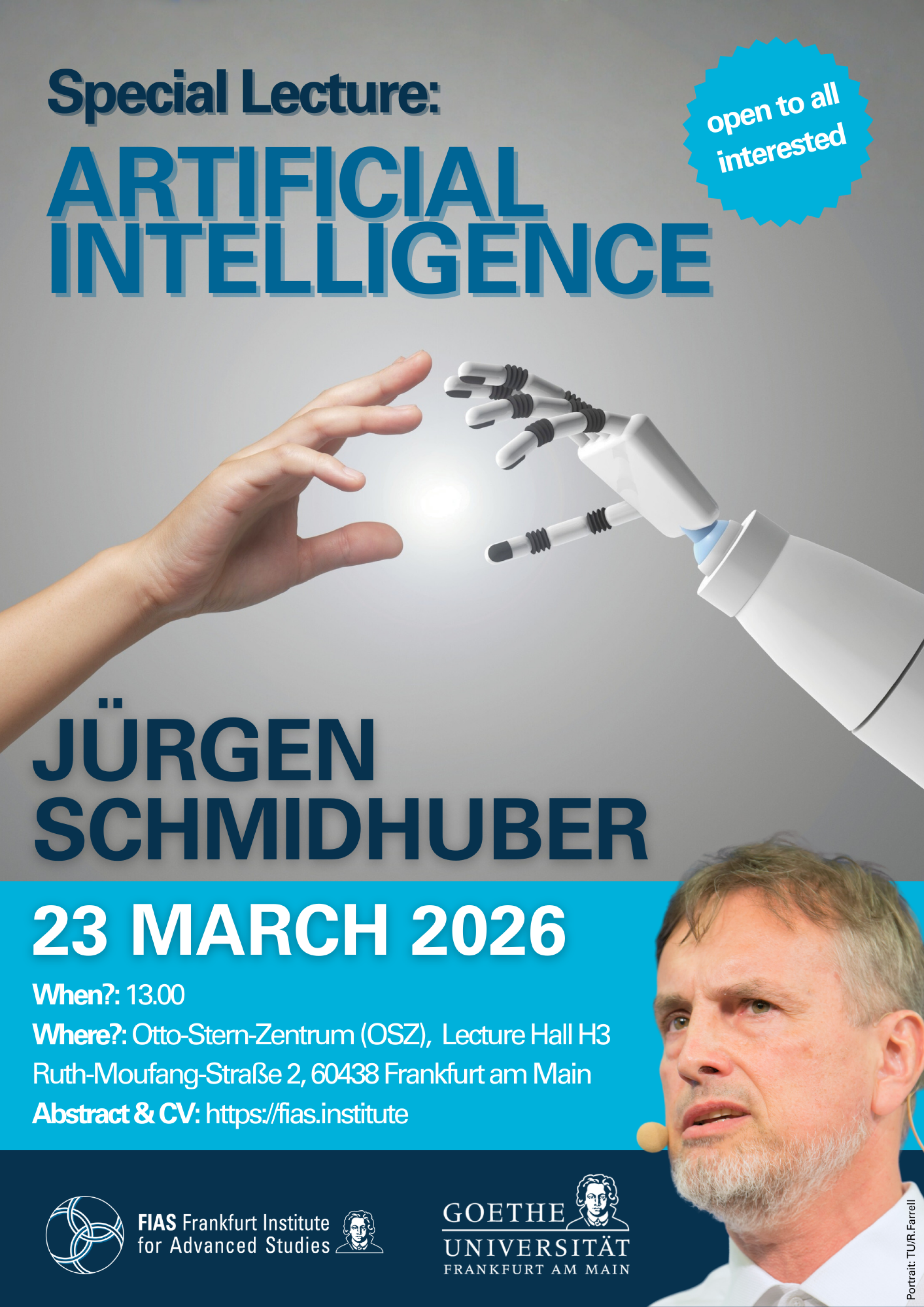
Veranstaltungsort: Otto-Stern-Zentrum (OSZ), Hörsaal H3
Künstliche Intelligenz prägt bereits heute viele Bereiche unseres Lebens – und steht dennoch erst am Anfang ihrer Entwicklung. Mit Prof. Dr. Jürgen Schmidhuber begrüßt das FIAS einen der international einflussreichsten Pioniere der modernen AI-Forschung.
Als Direktor von IDSIA (Schweiz) und Leiter der AI Initiative an der KAUST (Saudi-Arabien) hat Schmidhuber zentrale Grundlagen für heutige KI-Systeme mitentwickelt – von neuronalen Netzwerken bis hin zu Konzepten, die aktuellen Anwendungen wie generativer AI zugrunde liegen.
In seinem Vortrag zeichnet er die Entwicklung der Künstlichen Intelligenz seit den 1990er-Jahren nach und gibt einen Ausblick auf kommende Durchbrüche. Dabei geht es nicht nur um digitale Anwendungen, sondern auch um die zunehmende Verlagerung von AI in die physische Welt – von Robotik bis hin zu selbstlernenden Maschinen. Gleichzeitig beleuchtet er die gesellschaftlichen Auswirkungen und langfristigen Perspektiven dieser Technologie.
Der Vortrag:
Titel: Artificial Intelligence
Sprecher: Prof. Dr. Jürgen Schmidhuber, Director des IDSIA, Schweiz und Direktor der AI Initiative, KAUST, Saudi-Arabia.
Datum: Montag, 23. März, 13:00 Uhr Ort: Otto-Stern-Zentrum (OSZ), Hörsaal H3, Ruth-Moufang-Straße 2, Frankfurt am Main
Abstract (in englisch): Everybody is talking about AI. However, everything that we have seen so far in AI is nothing compared to what's going to come. Let's first provide some historic context. Modern AI emerged around 1990 when the Cold War ended, the WWW was born, the first smartphone was created, the first self-driving cars appeared in traffic, and my little TUM AI lab published foundations of the two most frequently cited scientific articles of all time (with the most citations within 3 years - manuals excluded), while laying the foundations of Generative AI and ChatGPT. I’ll discuss how in the 2000s this has begun to impact billions of human lives, how AI will continue to make human lives longer and healthier and easier, how AI will benefit all (not just a few big companies), how sophisticated blue collar workers in the physical world will gain a temporary advantage over white collar workers behind the screen. I'll discuss how AI will eventually spread from the virtual world behind the screen into the much more challenging physical world of robots, factories, and machines, eventually culminating in life-like, self-replicating and self-improving machine civilisations, which represent the ultimate form of upscaling. I'll also discuss what will happen in the next 40 billion years.
Mini-Biography: The NY Times headlined: "When A.I. Matures, It May Call Jürgen Schmidhuber 'Dad'." His team introduced principles of (1) the P in ChatGPT, (2) the T in ChatGPT, (3) neural net distillation (key for DeepSeek), (4) GANs for neural World Models, (5) LSTM, the most cited AI of the 20th century, and (6) the basis of the most cited paper of the 21st century.