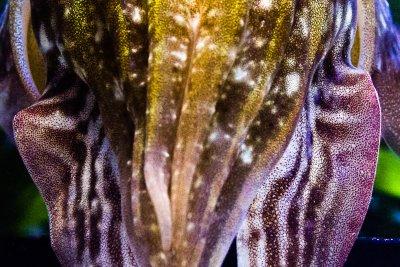
The unique ability of cuttlefish, squid and octopuses to hide by imitating the colors and texture of their environment has fascinated natural scientists since the time of Aristotle. Uniquely among all animals, these mollusks control their appearance by the direct action of neurons onto expandable pixels, numbered in millions, located in their skin. Scientists at the Max Planck Institute for Brain Research (MPI Brain Research), and the Frankfurt Institute for Advanced Studies (FIAS) and Goethe University (GU) used this neuron-pixel correspondence to peer into the brain of cuttlefish, inferring the putative structure of control networks through analysis of skin pattern dynamics. The scientists report their findings in the journal Nature.