4 February 2026
Light-switchable drugs and lipids
FIAS team investigates photoswitchable inhibitors and develops light-controlled therapeutics
In two publications, the group led by FIAS Fellow Sebastian Thallmair presents biological agents that can be switched using light. One target is an enzyme that plays a role in Alzheimer's or Parkinson's disease. The other is a lipid that makes that can be used to specifically modify cell membranes with the help of light.
Doctoral candidate Thilo Duve investigated a novel active ingredient whose effect can be switched on and off with light. The target is an enzyme in the brain (JNK3) that plays a role in neurodegenerative diseases such as Alzheimer's or Parkinson's.
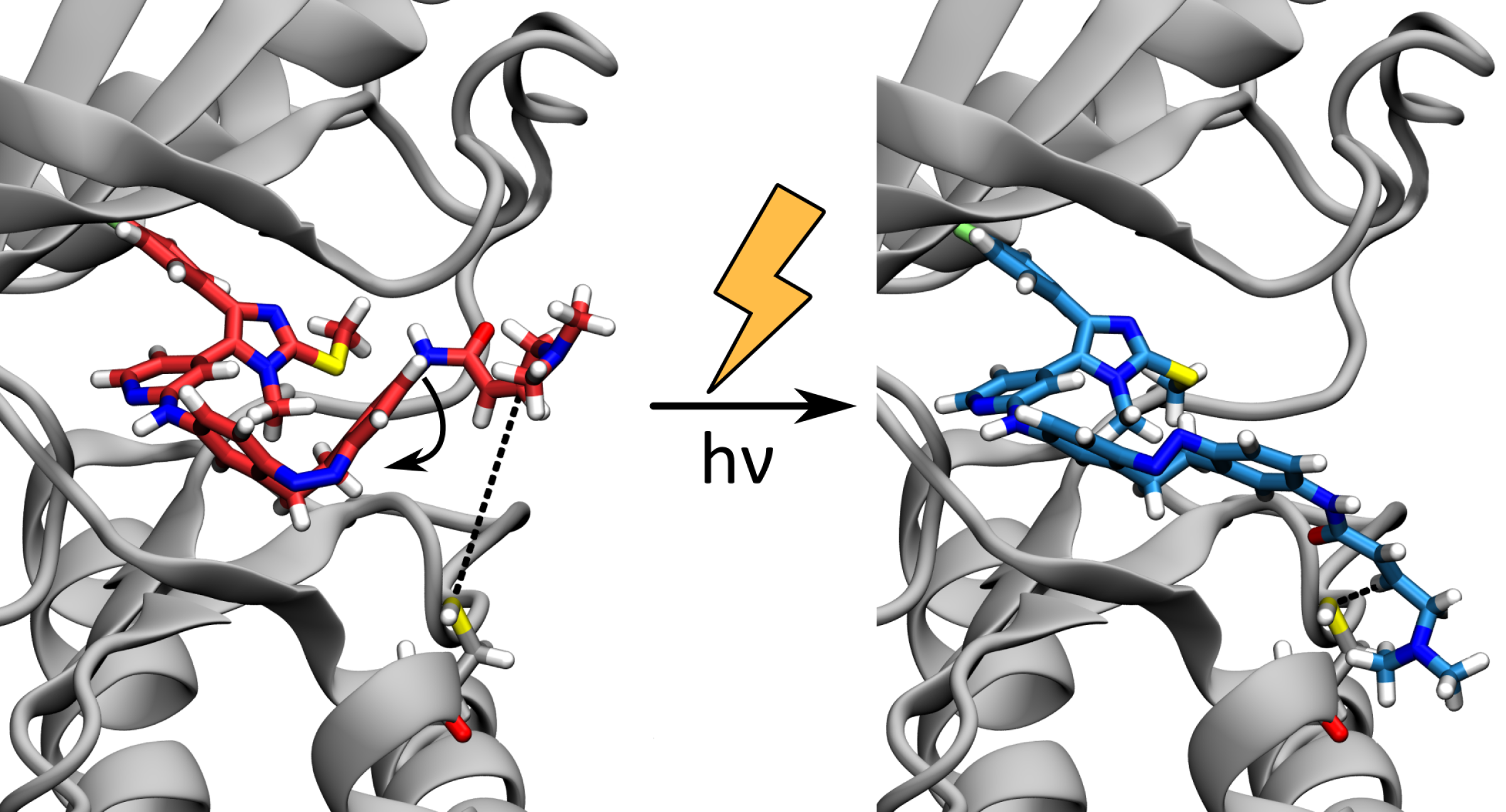
The drug contains a photoswitch: it changes its shape when exposed to light. Without light, the molecule is in a “bent” form and is hardly effective. When irradiated with blue light, the molecule stretches and becomes effective.
Using molecular dynamics simulations, the group investigated how the different forms of the light-switchable active ingredient interact with the target enzyme and why only the light-activated form is active. When the photoswitch stretches, the active ingredient comes into contact with a cysteine in the target enzyme. A chemical bond forms between the active ingredient and the protein, inhibiting the enzyme's function. Although the active ingredient can return to its “inactive” form, the enzyme remains blocked. The state of the active ingredient also influences the shape and mobility of the enzyme.
The team's work demonstrates at the molecular level how active substances can be controlled with light. This is an important step toward more targeted therapies, reduced side effects, and drugs that work only when and where they are needed through the application of light.
Doctoral candidate Cristina Gil Herrero is taking another approach to manipulating biological systems with light, using photolipids. These lipids contain a photoswitch, which allows their shape to be changed using light.These photolipids can specifically alter the properties of cell membranes—for example, their thickness, permeability, or organization. The team developed computer models that can be used to simulate light-switchable membrane systems very efficiently. The computer models can digitally replicate important experimental properties such as membrane thickness and surface area. The group shows that these models can be used in a variety of ways, for example to study the formation of domains or membrane proteins.
The investigations provide molecular insights into the complex dynamics of photoswitchable inhibitors and the future development of light-controlled therapeutics.
Publications:
Thilo Duve, Sebastian Thallmair, Photopharmacology in Action: Conformational Landscape of a Photoswitchable Covalent Kinase Inhibitor, The Journal of Physical Chemistry B, 2026, doi: 10.1021/acs.jpcb.5c05821
Cristina Gil Herrero, Thilo Duve, Sebastian Thallmair: Martini 3 Coarse-Grained Models of Azobenzene-Based Photolipids: Modulation of Membranes with Light, Journal of Chemical Theory and Computation 2026, doi: 10.1021/acs.jctc.5c01654