20 February 2026
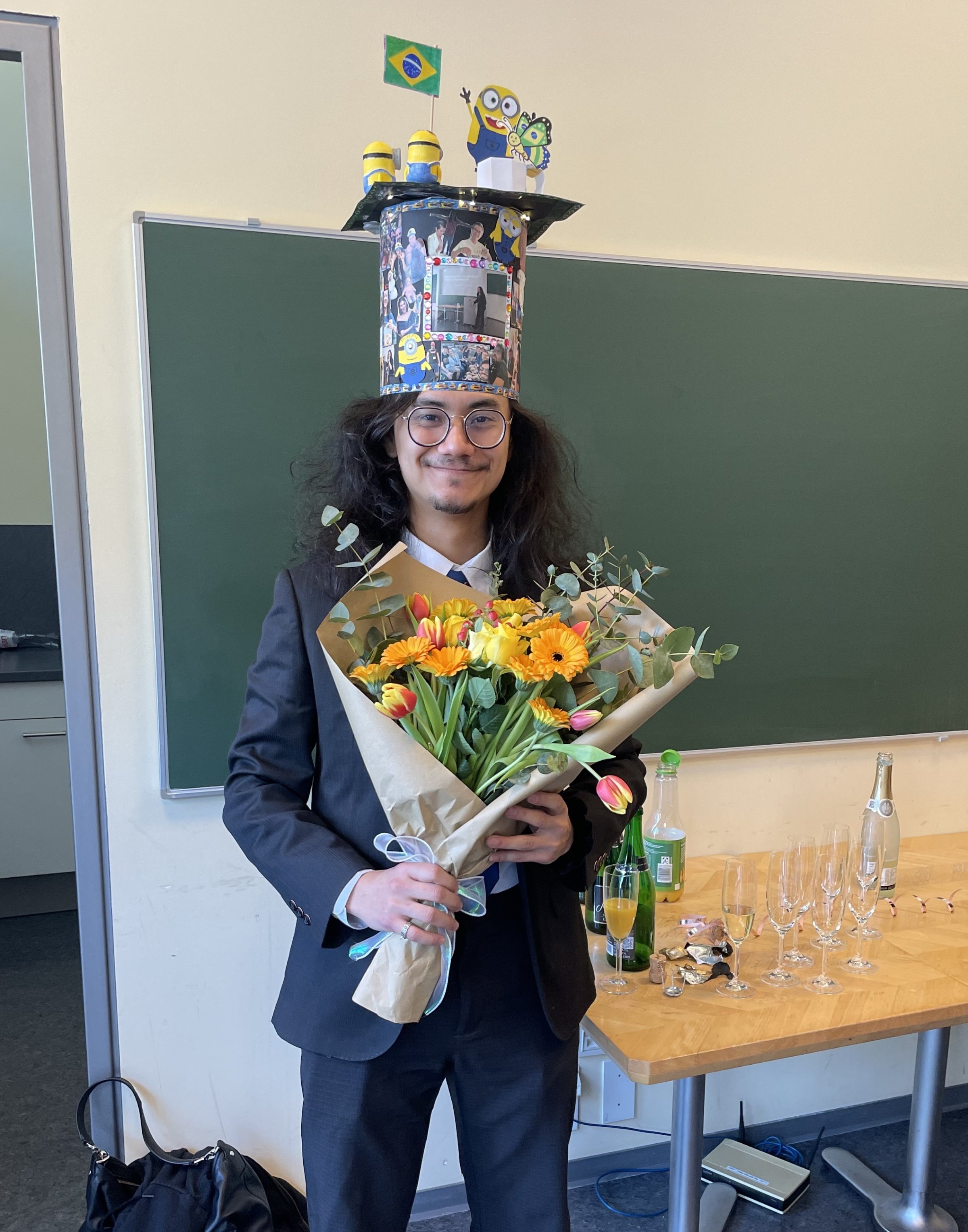
PhD of Renan Hirayama
Understanding matter in extreme thermodynamic conditions
Renan Góes-Hirayama finished his PhD in the group of FIAS Fellow Hannah Elfner in February. He studied how the electromagnetic radiation produced in collisions of heavy nuclei - such as those performed at CERN (Genebra) and GSI (Darmstadt) - can be used to understand the building blocks of matter.
In these heavy-ion collisions, pairs of electrons and positrons (anti-electrons) are sometimes produced. Since they do not interact via the strong force, they leave the collision undisturbed, and reflect the thermodynamic conditions of the medium that produced them. During his PhD, Hirayama developed a state-of-the-art framework that links particle-transport and fluid-dynamic approaches, with which he calculated the properties of this radiation for a large range of beam energies.
Like most research in this field, the work involved several areas of physics, from statistical mechanics to quantum chromodynamics, and also a lot of programming. The effort was worth it, and Hirayama will continue working on this topic during a postdoc at McGill University (Canada), starting in September: “I believe this area to be the most promising for understanding matter in extreme thermodynamic conditions.“