Research at FIAS: Biologically Inspired Computing
How can biological systems inspire new forms of computing?
At FIAS, scientists are researching how biological systems learn, adapt, and organize themselves, and how these principles can be transferred to novel computing methods. Building on its long tradition of theoretical research into complex, dynamic systems, our institute combines mathematical modeling, simulations, and interdisciplinary collaboration to open up new perspectives on information processing.
The focus is on interdisciplinary basic research that examines sustainable, efficient, and comprehensible computing methods while paving the way for future applications. The research focus on biologically-inspired computing ties in with the central idea of FIAS, which is to understand the similarities and interactions between very different mechanisms – from physical many-body systems to neural networks in the brain. And this strengthens the institute as a place where new scientific approaches emerge at the interfaces between disciplines.
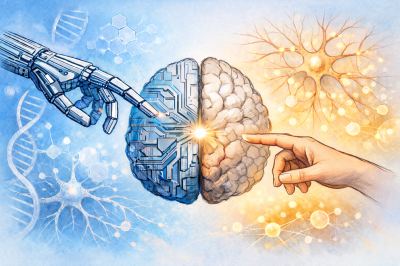
Interdisciplinary research environment
FIAS offers an environment in which interdisciplinary collaboration is part of everyday scientific life. Fellows from different disciplines develop joint research questions and projects at the interface between theory and application. New fellowship formats will further strengthen this dynamic and, in particular, give young researchers space for innovative ideas.
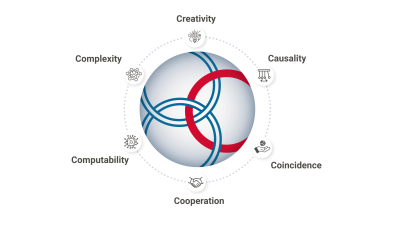
Fundamental Research for the Future
Basic research remains the foundation of FIAS. At the same time, biologically inspired computing bridges the gap between theoretical concepts and future technological developments. Strategic collaborations enable scientific findings to be transferred to new fields of application without losing focus on curiosity-driven research.
With this research focus, FIAS is further expanding its role as an interdisciplinary hub and exploring how a deeper understanding of biological principles can inspire the next generation of computing methods.
Research Areas
Theoretical natural sciences
Theoretical natural sciences combine topics from heavy ion and astrophysics, seismology, and renewable energies. They use both classical approaches and modern deep learning methods.
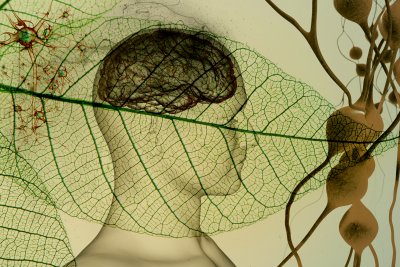
Life- and Neurosciences
Modern life sciences and neuroscience are increasingly characterized by mathematical and quantitative approaches—in no other discipline are the challenges of theory, modeling, and simulation growing so rapidly.
Computer science and AI systems
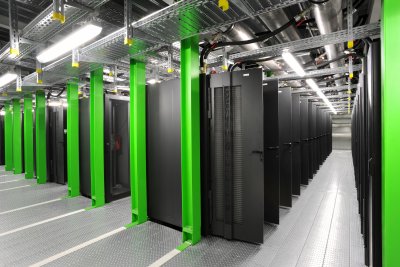
Supercomputers have long been an indispensable tool in research. Only with them is it possible to simulate complex processes and analyze large amounts of data.