27 March 2026
FIAS Forum on Consciousness
How human will AI become?
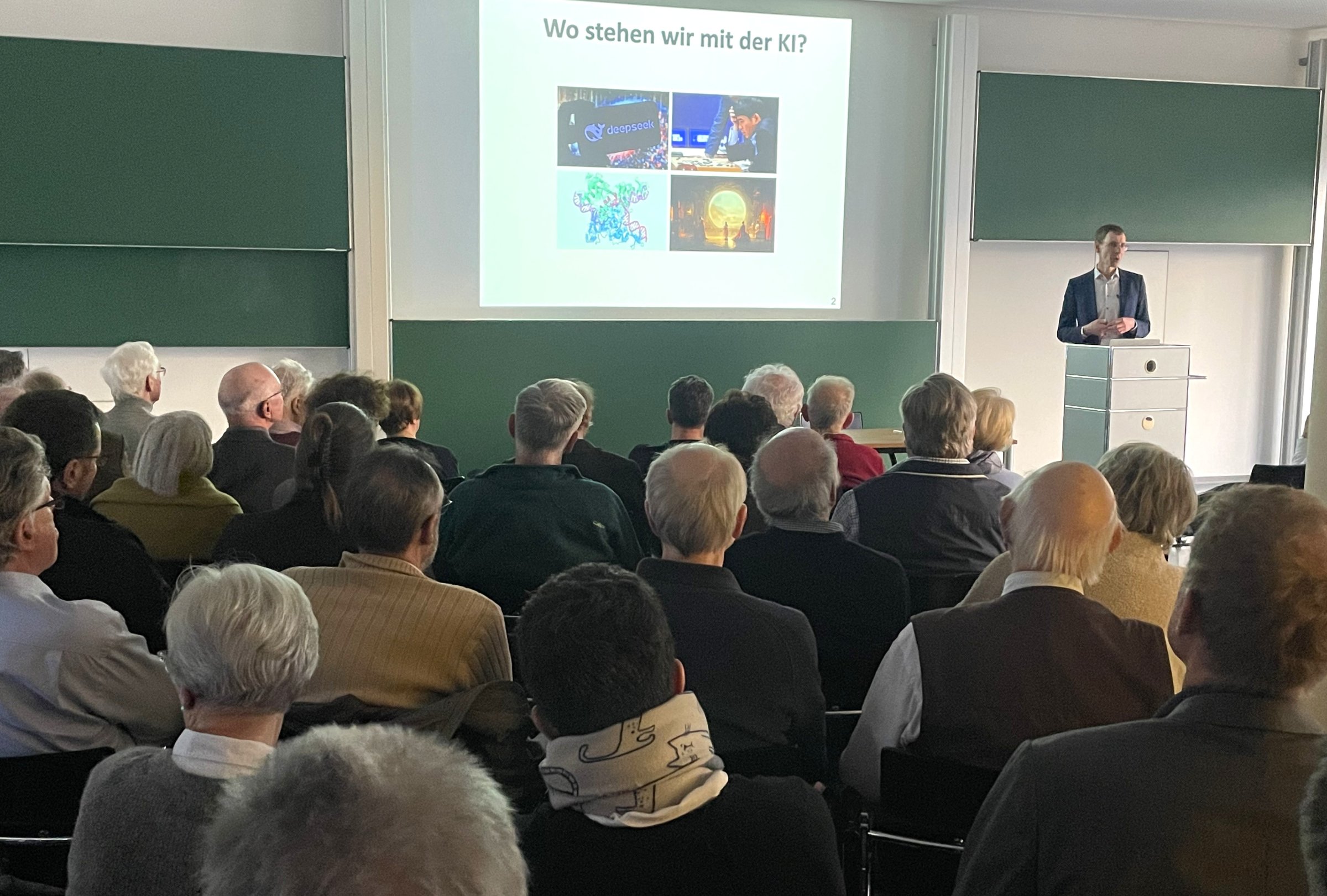
FIAS Senior Fellow Jochen Triesch demonstrated just how closely the natural sciences are linked to philosophical questions in his lecture on consciousness and intelligence, held on March 26 at the FIAS Forum. In addition to defining these concepts, the lecture focused on “replicating” human learning and comparing it with artificial intelligence (AI). The approximately 80 guests were enthusiastic and engaged in lively discussion afterward.
In two videos, Triesch demonstrated the possibilities and current limits of AI: While a humanoid robot can already play tennis (almost) perfectly, a chatbot struggles to apply the laws of physics realistically to everyday situations. Triesch illustrated just how complicated the definition of intelligence and consciousness is using examples: When do they begin in a baby? How “conscious” are we while sleeping?
To clarify these questions, science is attempting to break consciousness down into individual building blocks, such as motivation, coordination, planning, questioning, and personal memory. “So far, there is no AI system that incorporates all these defined building blocks,” said Triesch.
His research group is using a digital twin to investigate how our brain learns. With MIMo, they have created a virtual child that grows, learns, and develops its senses realistically. In collaboration with developmental psychologists, MIMo gets to know its environment and itself, thereby expanding its knowledge. For example, it should behave similarly to a real child when faced with a simulated mirror.
“AI systems with a form of consciousness are already on the horizon,” says Triesch. However, he points out a danger: they must never be allowed to define their own goals. The computational cost of such digital models is also very high—so even MIMo has to “forget” things in order to save resources.
In the lively discussion that followed, questions arose regarding a broad spectrum of consciousness: social behavior, recognition of a “self,” shame, and social interaction. It became clear that many questions remain unanswered here, but that tremendous new perspectives are opening up, ranging from life sciences and computer science to the very heart of philosophy.