31 March 2026
PhD Gianmarco Lazzeri
Simulation Intelligence for Rare Events in Biomolecular Processes
Gianmarco Lazzeri successfully defended his PhD today. He has been working on molecular dynamics simulations of complex membrane-protein systems in the laboratory of FIAS Senior Fellow Roberto Covino. His research combines artificial intelligence with rigorous statistical mechanics and rare-event theory to study biomolecular processes that are difficult to capture using conventional simulations.
One example of such a process occurs during autophagy, the cellular degradation process: the interaction between the Atg3/LC3 protein complex and membranes. Lazzeri helped clarify how the amphipathic helix of the Atg3 protein can act as a kind of messenger between the autophagophore membrane and the LC3 antibody, supporting the progression of the signaling pathway.
A central challenge in this field is that many important molecular transitions are rare events: they occur on timescales that are often inaccessible to straightforward molecular dynamics, where much of the computational effort is spent waiting for something relevant to happen. Therefore, Lazzeri focused primarily on method development.
In particular, he worked on Artificial Intelligence for Molecular Mechanism Discovery (AIMMD), an advanced, reinforcement learning-based strategy for investigating molecular mechanisms. The method combines path sampling with machine learning to initialize and control many short simulations in a coordinated and efficient manner. During his doctoral studies, Lazzeri significantly expanded the method and demonstrated its utility on challenging systems with rare events, such as the dimerization of transmembrane proteins.
His doctoral thesis covered various aspects, ranging from theoretical development and AI modeling to algorithm design, implementation, and parallelization. He also developed a robust reweighting procedure that makes it possible to combine many short simulations into a consistent overall picture. This allows information that one would expect from a much longer simulation to be effectively reconstructed—and with far greater efficiency. Furthermore, he improved the underlying path-sampling strategy with a novel rejection-free approach that enhances exploration without sacrificing efficiency.
The highly interdisciplinary doctoral thesis initially posed a challenge, but enabled Lazzeri to develop a broad range of skills and to collaborate closely with experimentalists and theoretical chemists. “It was a demanding but very stimulating experience—and it also allowed me to travel abroad for conferences and lab visits.”
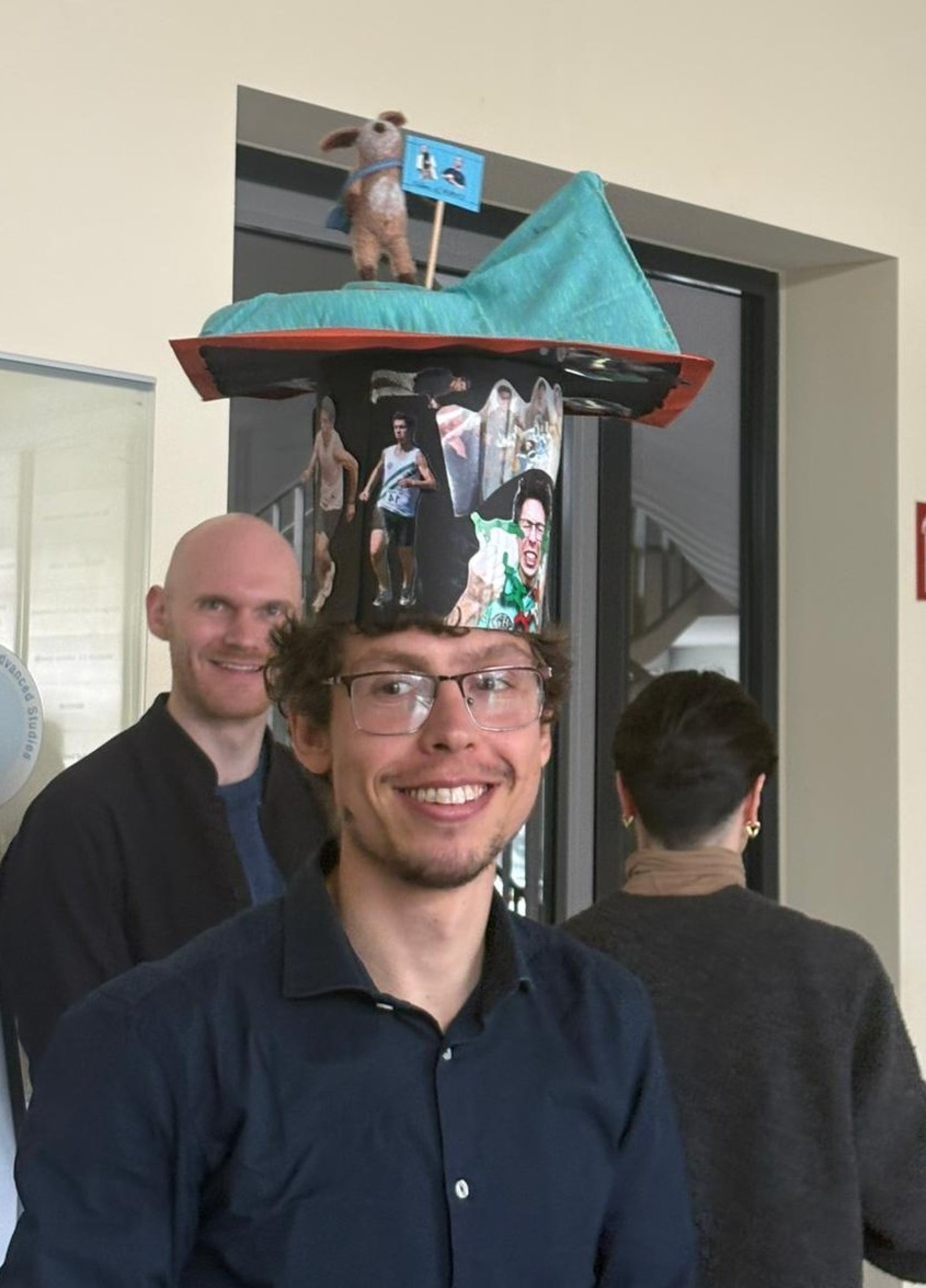
Lazzeri also took part in many activities at FIAS. Particularly noteworthy are his successful participations in the J.P. Morgan Run in Frankfurt—eleventh-best time and 23rd place worldwide!—as well as his victory in the 2025 Goethe Run.
He will soon start as a postdoc in Cecilia Clementi’s lab at the Free University of Berlin, where he will work on optimizing a coarse-grained AI force field for biomolecular systems.
Publications ( †: first author)
E. Jackel†, G. Lazzeri†, & R. Covino (2025). Free energy, rates, and mechanism of transmembrane dimerization in lipid bilayers from dynamically unbiased molecular dynamics simulations. J. Phys. Chem. B, 129, 1586–1596.
G. Lazzeri†, H. Jung, P.G. Bolhuis, & R. Covino (2023). Molecular free energies, rates, and mechanisms from data‑efficient path sampling simulations. J. Chem. Theory Comput., 19, 9060‑9076.
T. Nishimura†, G. Lazzeri†, N. Mizushima, R. Covino, & S. A. Tooze (2023). Unique amphipathic ɑ helix drives membrane insertion and enzymatic activity of ATG3. Sci. Adv., 9, eadh1281.
G. Lazzeri†, C. Micheletti, S. Pasquali, & P. Faccioli. (2023). RNA folding pathways from all‑atom simulations with a variationally improved history‑dependent bias. Biophys. J., 122, 3089‑3098.
S. A. Tooze†, W. Zhang, G. Lazzeri, D. Gahlot, L. Thukral, R. Covino, & T. Nishimura (2024). Membrane association of the ATG8 conjugation machinery emerges as a key regulatory feature for autophagosome biogenesis. FEBS Lett., 598, 107‑113.
T. Nishimura†, G. Lazzeri, S. A. Tooze, & R. Covino (2024). ATG3 proteins possess a unique amphipathic ɑ‑helix essential for the Atg8/LC3 lipidation reaction. Autophagy, 20, 212‑213.
G. Lazzeri†, P. G. Bolhuis, & R. Covino (2025). Optimal Rejection‑Free Path Sampling. arXiv preprint arXiv:2503.21037.