18 March 2026
INTERACTION: New Funding Program at FIAS
Local networks in the brain control perception
How does the brain process sensory stimuli—and what role do the connections between neighboring neurons play in this process? The new research project INTERACTION is dedicated to addressing this central question in neuroscience. The goal is to understand how local networks in the brain convert incoming signals into structured patterns of activity, thereby laying the foundation for perception.
In the brain, sensory impressions are not simply relayed. Rather, complex patterns of activity emerge from the interplay of incoming signals and the lateral connections between nerve cells. In theoretical models, these interactions have long been considered crucial for information processing in the cerebral cortex. Nevertheless, their exact structure has hardly been investigated to date.
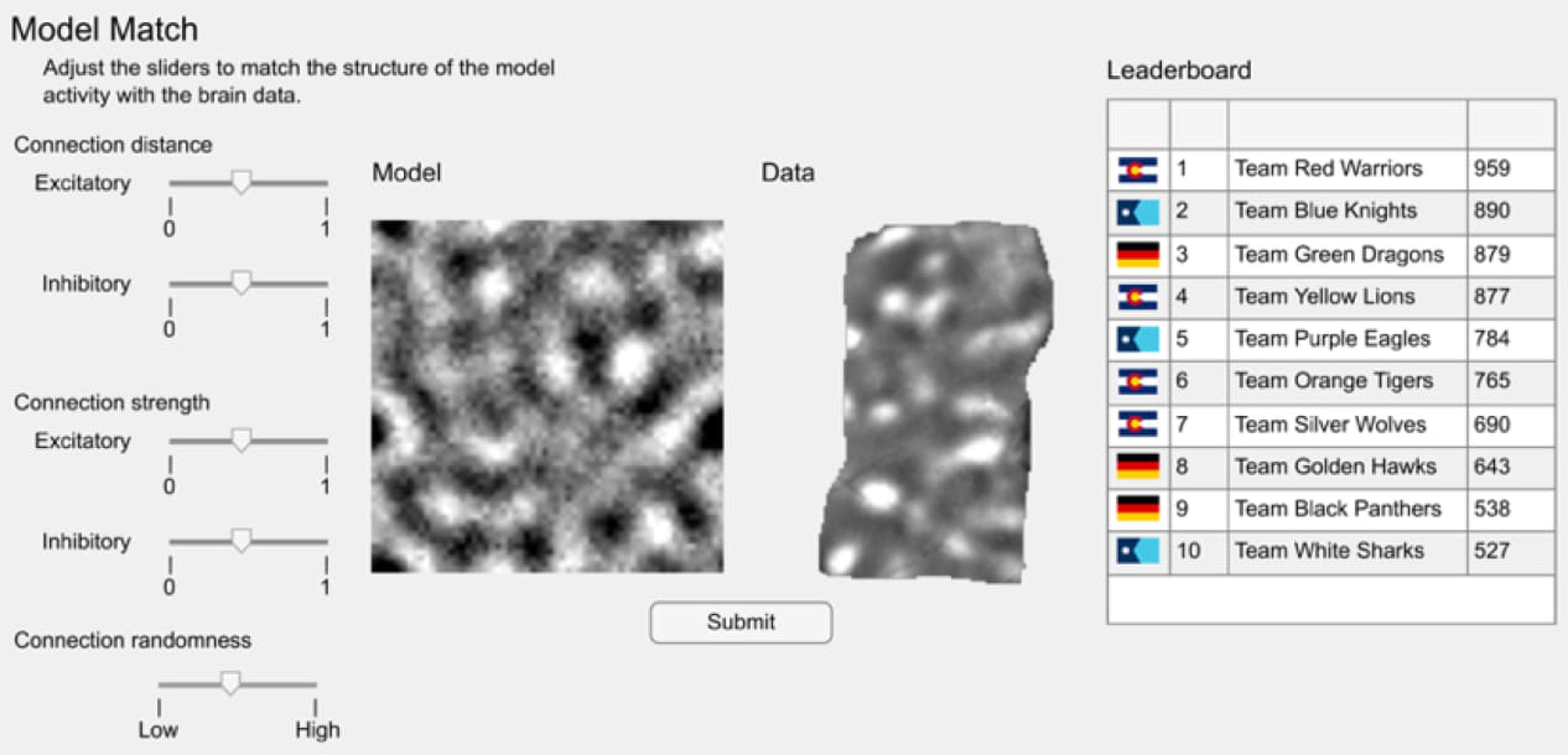
The INTERACTION project combines modern experimental methods with theoretical modeling to systematically analyze these processes for the first time. Experimental partners in the U.S. use optogenetics—a method in which nerve cells are selectively activated with light—to measure the activity and interactions of nerve cells in the developing visual cortex. In parallel, the group led by FIAS Senior Fellow Matthias Kaschube at FIAS is developing computer models of the networks in the cerebral cortex designed to quantitatively describe and explain these data. By comparing model predictions with experimental measurements, they can reconstruct the underlying network structures.
A particular focus is on early brain development. During this phase, large-scale patterns of activity emerge, even though many long-range connections are still absent. Previous work by the participating teams shows that such patterns can arise through the self-organization of neural activity—in particular through the interplay of local excitation and lateral inhibition. INTERACTION will now investigate how these mechanisms specifically influence the processing of sensory input.
Furthermore, the project aims to clarify whether similar organizational principles also occur in other brain regions. This could lead to the identification of fundamental principles of information processing in the brain.
The Federal Ministry of Research, Technology, and Space (BMFTR) is funding INTERACTION as part of the three-year initiative “Bilateral Cooperation in Computational Neuroscience: Germany – USA” over a three-year period. INTERACTION combines theoretical research at FIAS with experimental work at the University of Minnesota and the University of Colorado Anschutz. The close collaboration between modeling and experimentation is expected to yield new insights into the functioning of cortical networks—knowledge that could also be significant in the long term for the development of novel neurotechnological applications and therapies.