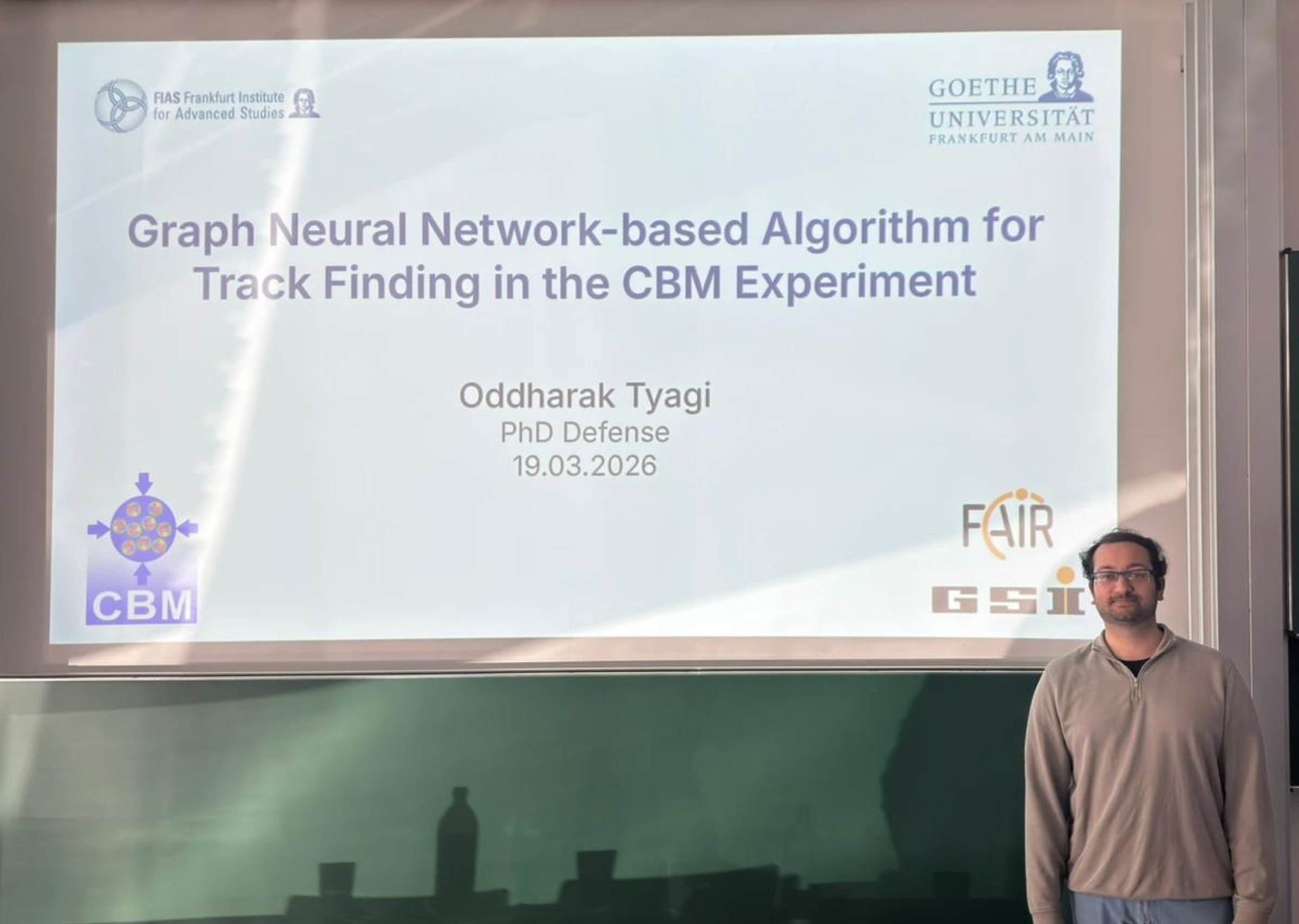
19 March 2026
PhD Oddharak Tyagi
Recreating the events following the Big Bang
Oddharak Tyagi successfully defended his dissertation at FIAS. Working in the research group of FIAS Fellow Ivan Kisel, he developed an algorithm that helps us understand the processes immediately following the Big Bang.
The Compressed Baryonic Matter (CBM) experiment aims to recreate the extreme conditions just after the Big Bang by colliding heavy ions at very high energies. To capture the rare processes that reveal the properties of dense nuclear matter, the experiment will produce millions of collisions every second and generate raw data on the order of terabytes per second. This data volume is far too much to store directly. The central challenge is therefore to identify the most important events in real time without losing the physics we care about.
During his PhD Tiyagi developed a new, hybrid track-finding algorithm that combines modern, data-driven deep learning with traditional physics tools. The method uses graph-based neural networks together with Kalman-Filter tracking and physics-motivated selection rules, which keeps the reconstruction both powerful and physically interpretable. A novel cooperative selection scheme further increases the number of correctly reconstructed particle trajectories in the dense environment of acollision.
The algorithm delivers state-of-the-art improvements in reconstruction efficiency, particularly for low-momentum and short-lived particles that are otherwise hard to detect, and it raises the yield of key decay products that CBM is designed to study. Furthermore, by integrating and testing the algorithm in the software stack of CBM, and providing an initial GPU implementation, this work emerges as a strong candidate for use in the CBM experiment.
Tyagi will start working as an AI Researcher at the consulting company EY soon. FIAS congratulates on earning the doctorate and wishes him all the best!