18 March 2026

INTERACTION: New Funding Program at FIAS

Local networks in the brain control perception

How does the brain process sensory stimuli—and what role do the connections between neighboring neurons play in this process? The new research project INTERACTION is dedicated to addressing this central question in neuroscience. The goal is to understand how local networks in the brain convert incoming signals into structured patterns of activity, thereby laying the foundation for perception.

more

11 March 2026

How our brain works: a night-long experience!

Frankfurt hat Hirn 2026 - Frankfurt has brains 2026

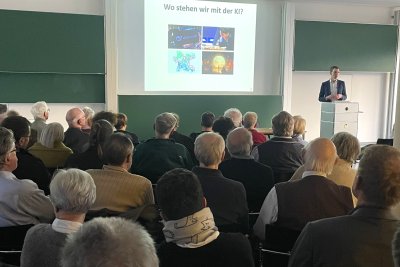
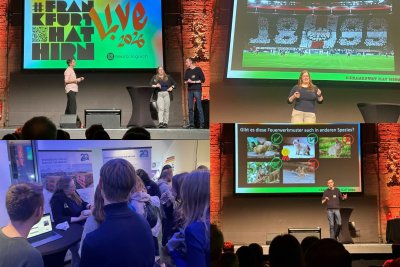
On March 10, Frankfurt's neuroscience institutions demonstrated how much brainpower the city has to offer with a fantastic event: in short, colorful presentations, young researchers took the audience into the world of brain research.

more

3 March 2026

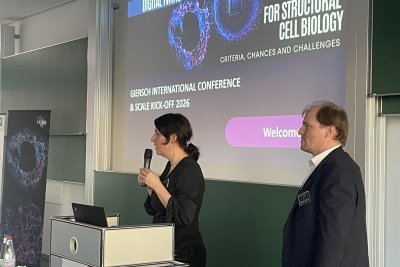
Successful Giersch conference

Kick-off of SCALE Cluster of Excellence

The 2026 Giersch Conference at FIAS also marks the kick-off event for the SCALE Cluster of Excellence. The motto: “Towards digital twins for structural cell biology – criteria, chances, and challenges.”

more
Renan Hirayama

20 February 2026

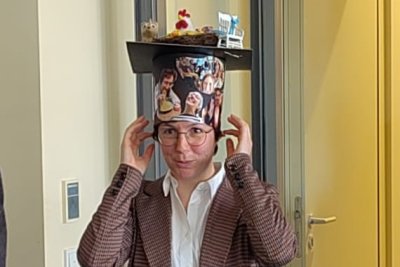
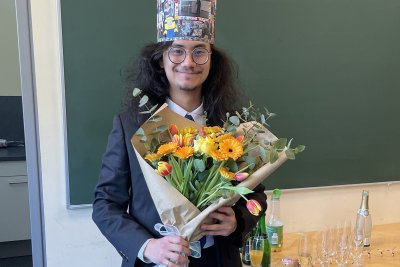
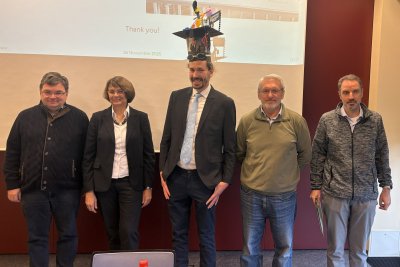
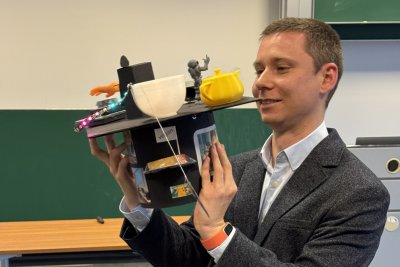
PhD of Renan Hirayama

Understanding matter in extreme thermodynamic conditions

Renan Hirayama finished his PhD in the group of FIAS Fellow Hannah Elfner in February. During his PhD he studied how pairs of particles called dileptons are produced when heavy atomic nuclei collide at very high speeds. He did this for all available beam energies, using a combined method that links particle-transport simulations with fluid-dynamics calculations.

more

19 February 2026

PhD of Camile Fraga Delfino Kunz

Understanding coupled pattern-forming systems

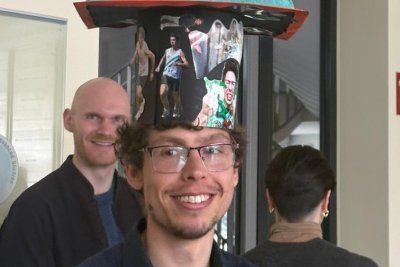
Camile Fraga Delfino Kunz successfully defended her doctoral thesis in Bioinformatics at Goethe University Frankfurt on 19 February. In her work at Franziska Matthäus' group at FIAS, she investigated how complex biological patterns. She explored how complex biological patterns — such as those underlying hair follicle and feather bud formation — emerge from the interaction of two fundamental mechanisms: diffusion-driven instability and chemotaxis. While each process can independently generate spatial structures, her work focused on uncovering what new behavior arises when both mechanisms are coupled within a single mathematical model.

more

19 February 2026

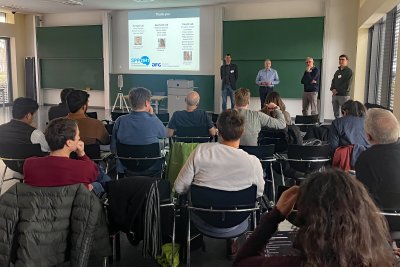
Final status meeting of SPP-2041

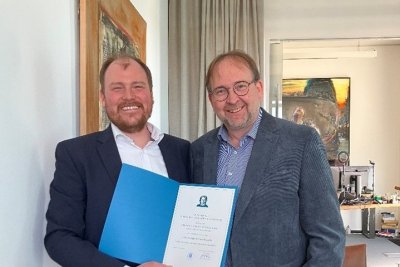
From January 27–29, 2026, the final status meeting of SPP‑2041 was held at the Frankfurt Institute for Advanced Studies (FIAS) in Frankfurt. Over three days, participating groups presented their latest results through talks and poster sessions, highlighting major advances across experimental, theoretical, and computational connectomics.
more

4 February 2026

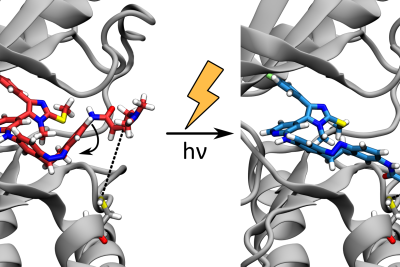
Light-switchable drugs and lipids

FIAS team investigates photoswitchable inhibitors and develops light-controlled therapeutics

In two publications, the group led by FIAS Fellow Sebastian Thallmair presents biological agents that can be switched using light. One target is an enzyme that plays a role in Alzheimer's or Parkinson's disease. The other is a lipid that makes that can be used to specifically modify cell membranes with the help of light.

more

11 December 2025

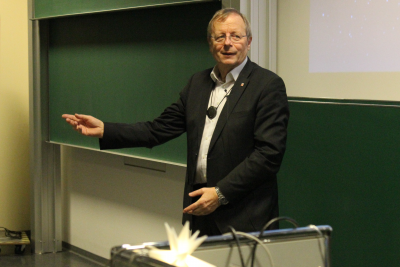
Christmas lecture 2025

Advent in the universe

FIAS Director Jan Wörner gave a Christmas lecture entitled “Advent in the Universe.” He reflected on the period from the creation of the universe over the course of a year and the Advent season, right up to an outlook for the new year.

more

10 December 2025

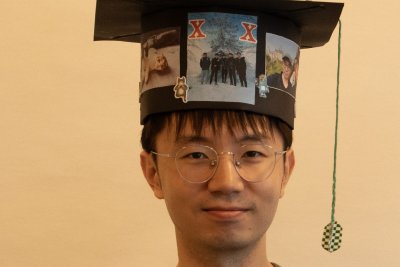
PhD of Xia Xu

From infants to AI

Xia Xu defended his thesis in the group of Jochen Triesch on December 10. He studied how infant-inspired learning can lead to the next level of developmental AI.

more

10 December 2025

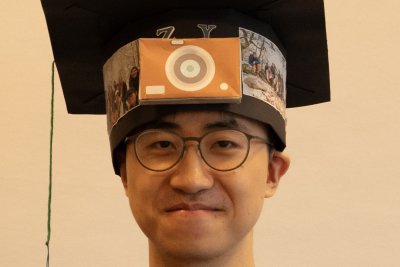
PhD defense of Zhengyang Yu

Learning to see and deep learning

Zhengyang Yu finished his PhD in the group of Jochen Triesch on December 10th. “We hope to build a bridge between infant vision and deep learning,” Yu says. In his PhD thesis he shows that representation learning can benefit from the same kind of natural, continuous visual experience that toddlers gain through active, self-directed exploration. By replacing traditional data augmentation with temporally adjacent frames from real visual play sequences, his self-supervised model learned robust object representations comparable to those achieved with full supervision.

more

26 November 2025

PhD defense of Artemiy Belousov

Neural networks detect rare events in heavy-ion collisions

Experiments with tiny particles of large mass—such as compressed baryonic matter (CBM)—are an important pillar of the Facility for Antiproton and Ion Research (FAIR) in Darmstadt. The CBM experiment at the FAIR accelerator will record up to ten million heavy ion collisions per second. Under these conditions, an online trigger is required to select events that may contain signatures of quark-gluon plasma. In his dissertation, supervised by FIAS Fellow Ivan Kisel, Artemiy Belousov investigated how neural-network approaches can support this task.

more

12 November 2025

PhD defense of Felix Weiglhofer

Software tracks particle collisions

Felix Weiglhofer's dissertation, supervised by FIAS Senior Fellow Volker Lindenstruth, addresses the question of how large amounts of data can be processed in real time. It enables rare particle interactions to be recorded and analyzed—and thus provides insight into the microseconds after the Big Bang.

more

31 October 2025

AI improves epidemic forecasts

FIAS researchers combine disease models with artificial intelligence to better understand how diseases spread.

More accurate predictions of epidemics are important for combating infectious diseases and protecting public health. A research team at the Frankfurt Institute for Advanced Studies (FIAS) has developed a new artificial intelligence (AI) for this purpose. It combines classic models of disease spread with modern deep learning methods to better capture differences in the temporal and spatial progression of an epidemic.

more

30 October 2025

PhD Tom Olsen

Computational basis for modeling extreme astrophysical systems.

Tom Olsen developed a novel method to compute radiation transport and radiation-matter interaction in the context of strong gravity and high energy physics. The dissertation was supervised by FIAS Senior Fellows Volker Lindenstruth and Luciano Rezzolla.

more
Disputation Armin van de Venn

10 October 2025

What shapes the universe: Doctoral thesis by Armin van de Venn

Torsion in space

Today, Armin van de Venn successfully completed his doctorate under the supervision of FIAS Fellow Jürgen Struckmeier - "summa cum laude". His extension of established mathematical frameworks opens up new perspectives on the deep structure of spacetime and the origin of the cosmos.

more

8 October 2025

Hackathon at FIAS

PhD Symposium at Bernstein Network

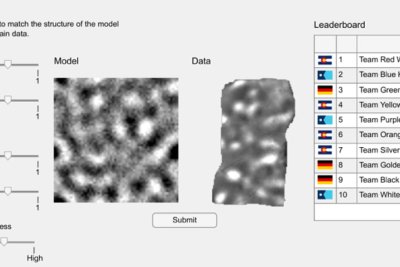
The PhD symposium connected to the Bernstein Conference was once again held at FIAS. This year's spotlight was the topic of consensus: Where do we agree, where don’t we, and why does it matter? The path to this question was a hackathon in which participants analyzed a data set in small groups and discovered that different answers to a scientific question can be found depending on the perspective and interpretation.

more

7 October 2025

Energy-efficient thinking: What AI can learn from the brain

FIAS researchers suggest new model for energy-efficient neural information processing.

Biological brains are extremely energy-efficient. Can artificial intelligence learn a few tricks from them? Researchers at FIAS and colleagues from France describe new findings on energy-efficient information processing in the journal Nature Communications.

more

26 September 2025

FIAS Forum: How computers model life

Two FIAS researchers described digital twins as a key to understanding biology at the FIAS Forum on September 25.

FIAS Fellows Roberto Covino and Sebastian Thallmair introduced the audience at the FIAS Forum to the world of computer models. Using clear and vivid imagery, they described how digital twins open up new avenues for research into cellular and health-related processes.

more

24 September 2025

Chen Li's PhD: Optimizing the use of power grids

Managing renewable energies with AI

Chen Li from the research group of FIAS Senior Fellow Horst Stöcker successfully defended his doctoral thesis on September 22, 2025. Using machine learning algorithms, he optimized decision-making problems in power grid models that arise due to fluctuations in renewable energies.

more

23 September 2025

FIAS team wins Babybot Paper Award

Prize at the International Conference on Development and Learning

A team around doctoral student Francisco M. López from the group of FIAS Senior Fellow Jochen Triesch won the “Babybot Paper Award.” It was presented at the International Conference on Development and Learning in Prague and honors publications that establish a connection between developmental psychology and robotics and/or computer-aided modeling.

more